
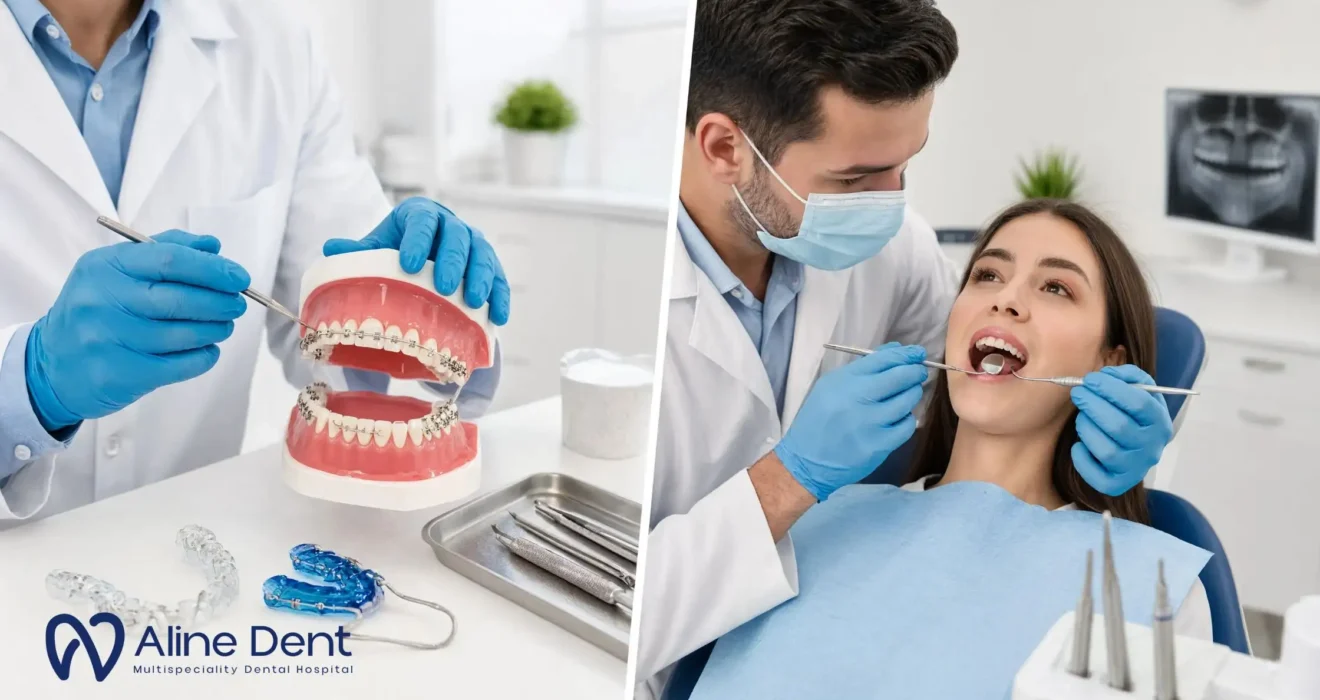
Orthodontist VS Dentist: What Is the Difference and Who Should You See?
When you have a toothache, cavity, sensitivity, or need a routine dental check-up, a dentist is usually the first professional you think of. But if your concern is crooked teeth, dental gaps, an overbite, crowded teeth, or an improperly aligned smile, what kind of care do you need?
This is where the distinction between a dentist and an orthodontist becomes important.
Although both professionals are dental specialists in the broader sense and both begin their careers with dental education, their areas of focus are different.General dentists provide care for your overall dental and oral health, while orthodontists specialise in correcting tooth alignment, bite issues, and jaw development.
Understanding orthodontist vs dentist can help you choose the right professional for your particular dental concern instead of assuming that every dental treatment should be handled by the same provider.
What Does a Dentist Do?
A dentist is your primary oral healthcare professional. General dentists diagnose, prevent and treat a wide range of conditions affecting the teeth, gums and other structures of the mouth.
Routine dental care commonly includes:
- Dental check-ups
- Professional teeth cleaning and scaling
- Cavity diagnosis and fillings
- Treatment of tooth sensitivity
- Root canal treatment
- Dental crowns and bridges
- Tooth extractions
- Gum care
- Preventive dental care
- Some cosmetic dental treatments
- Oral health education
A dentist can also identify problems that require specialist attention and refer the patient to an appropriate dental specialist when necessary.
For example, a dentist may notice that a child has significant crowding or an adult has a complex bite problem and recommend an orthodontic evaluation.
What Does an Orthodontist Do?
An orthodontist is a dental specialist who receives advanced training in orthodontics and dentofacial orthopedics. Their work centers on diagnosing, preventing, and correcting conditions associated with:
- Crooked or misaligned teeth
- Crowded teeth
- Gaps between teeth
- Overbite
- Underbite
- Crossbite
- Open bite
- Improper bite relationships
- Certain jaw-development problems
- Dental and facial alignment
Orthodontists use different appliances and treatment systems to gradually move teeth and, when appropriate, influence developing jaw relationships.
These may include traditional metal braces, ceramic braces, self-ligating braces, clear aligners and other orthodontic appliances.
Orthodontic treatment focuses on more than just improving the alignment and appearance of the teeth. Proper treatment also considers how the upper and lower teeth meet, how the teeth function during chewing, and how the teeth and jaws relate to one another.
Orthodontist vs Dentist: What Is the Main Difference?
The simplest way to understand the difference between orthodontist and dentist is to look at their primary areas of practice.
| Dentist | Orthodontist |
| Focuses on overall oral health | Focuses primarily on tooth and jaw alignment |
| Treats cavities and tooth decay | Treats crooked and crowded teeth |
| Performs fillings and restorative procedures | Corrects malocclusion and bite problems |
| Provides preventive dental care | Plans and monitors orthodontic tooth movement |
| Treats many common gum and dental problems | Treats overbites, underbites, crossbites and spacing problems |
| May provide some orthodontic treatment | Has specialist training specifically in orthodontics |
| May refer complex alignment cases to an orthodontist | Works specifically with orthodontic and dentofacial problems |
The two professions can overlap in certain areas, but they are not interchangeable. A dentist may provide some braces or aligner treatments, but providing an orthodontic appliance does not by itself make someone an orthodontist. Orthodontists pursue further specialized training beyond dental school to develop expertise in tooth movement, jaw alignment, and the growth and development of the face and jaws.
Dentist vs Orthodontist: Is an Orthodontist Also a Dentist?
Yes.
This is one of the easiest ways to understand the relationship between the two.
Every orthodontist is trained first as a dentist, but not every dentist specializes in orthodontics.
After completing dental education, a dentist who chooses orthodontics can pursue additional specialist training in the field. This further education focuses on the science and clinical management of tooth movement, bite correction and jaw development.
This advanced training gives orthodontists a specialized role beyond general dental care.
So, if you are confused about whether to see an orthodontist and dentist, the answer depends mainly on the type of dental problem you are experiencing.
When Should You See a Dentist?
A general dentist is usually the appropriate starting point for maintaining your overall oral health.
You should consider visiting a dentist for concerns such as:
Toothache
Pain can result from cavities, infection, cracks, sensitivity, gum problems or other dental conditions. A dentist can examine the tooth and determine the likely cause.
Cavities
Tooth decay should be treated before it progresses deeper into the tooth. Depending on its severity, treatment may involve preventive care, a filling or more extensive restoration.
Gum Problems
Bleeding gums, swelling, persistent bad breath and gum tenderness can be signs that your gums need professional evaluation.
Dental Cleaning
Regular professional cleaning can help remove plaque and tartar that cannot be completely eliminated through routine brushing alone.
Broken or Damaged Teeth
A dentist can assess a chipped, cracked or fractured tooth and determine whether it requires bonding, a filling, crown or another form of treatment.
Routine Dental Check-ups
Even when you have no pain, regular dental examinations can help identify developing problems before they become more complicated.
When Should You See an Orthodontist?
An orthodontic consultation is appropriate when your primary concern involves teeth alignment, bite or jaw relationships.
You may benefit from seeing an orthodontist if you have:
- Crowded teeth
- Large gaps between teeth
- Crooked teeth
- Overbite
- Underbite
- Crossbite
- Open bite
- Teeth that do not meet properly
- Difficulty maintaining oral hygiene because of crowding
- Concerns regarding how your child’s teeth are developing and aligning
- A desire to straighten teeth using braces or clear aligners
An orthodontist looks at more than just tooth alignment, assessing how the teeth meet and how the jaws are positioned in relation to each other.
Can a Dentist Put Braces or Clear Aligners?
A dentist may provide certain orthodontic treatments depending on their education, training, experience and applicable professional requirements.
However, a dentist offering braces or aligners does not automatically mean that the dentist is an orthodontist.
This distinction matters particularly when the case involves significant crowding, complex bite problems, jaw discrepancies or treatment requiring detailed orthodontic planning.
An orthodontist receives additional specialist education specifically focused on these issues. The American Association of Orthodontists describes orthodontists as specialists in moving teeth and aligning jaws, following additional orthodontic training after dental school.
Orthodontist vs Dentist for Braces
If you are considering braces, you may wonder whether you should simply visit your regular dentist.
Braces apply controlled forces to gradually move teeth. Successful treatment requires careful assessment, treatment planning and regular monitoring to make sure the teeth move in the intended direction while the bite remains functional.
An orthodontist can evaluate factors such as:
- The amount of crowding
- Tooth position
- Spacing
- Jaw relationship
- Bite pattern
- Facial growth
- Tooth movement requirements
- Expected treatment duration
- Retention after treatment
Depending on the case, an orthodontist may recommend metal braces, ceramic braces, self-ligating braces or another orthodontic approach.
Orthodontist vs Dentist for Clear Aligners
Clear aligners have become a popular option for people who want a more discreet alternative to traditional braces.
However, clear aligner treatment is still orthodontic treatment. The fact that the appliance is removable and nearly invisible does not mean that treatment planning is simple.
An orthodontist can assess whether aligners are appropriate for your specific type of tooth movement and bite correction.
Clear aligners may be considered for concerns such as:
- Mild to moderate crowding
- Spacing
- Certain bite problems
- Tooth rotations
- Alignment of selected cases
- Smile correction
More complex dental alignment issues may require braces or other orthodontic treatments. The right treatment depends on the individual’s dental and skeletal condition rather than simply choosing the most popular appliance.
Who Should Children See: Dentist or Orthodontist?
Children need both general dental care and, when indicated, orthodontic evaluation.
A dentist can monitor the health of primary and permanent teeth, identify cavities and provide preventive care. An orthodontist focuses on tooth eruption, alignment, bite development and certain jaw-related concerns.
An orthodontic evaluation does not necessarily mean that a child needs braces immediately.
In some children, the most appropriate approach may simply be monitoring growth and dental development. In others, early intervention may be useful depending on the problem.
The timing of orthodontic treatment is therefore individual rather than being based solely on age.
Can You See Both a Dentist and an Orthodontist?
Absolutely.
In fact, many patients benefit from having both professionals involved in their oral healthcare.
For example, a patient undergoing braces or clear aligner treatment may continue routine dental check-ups with their general dentist while the orthodontist manages tooth movement and bite correction.
The dentist can continue monitoring:
- Cavities
- Gum health
- Oral hygiene
- Tooth decay
- General oral health
Meanwhile, the orthodontist monitors:
- Tooth movement
- Bite correction
- Alignment
- Treatment progress
- Orthodontic appliances
- Retention
Good communication between dental professionals can make comprehensive care more coordinated.
How Is Orthodontic Treatment Planned?
Orthodontic treatment usually begins with a detailed assessment rather than immediately placing braces or giving aligners.
Depending on the patient’s needs, the orthodontist may evaluate:
- Dental alignment – The position of individual teeth is assessed.
- Bite relationship – The way the upper and lower teeth meet is examined.
- Jaw relationship – The relationship between the upper and lower jaws is considered.
- Facial profile – Facial balance can be relevant when planning certain orthodontic treatments.
- Dental development – In children and teenagers, growth and eruption patterns are important.
- Diagnostic records – Photographs, digital scans, X-rays or other records may be used when required.
- Treatment options – Braces, clear aligners or other appliances may be considered based on the case.
- Retention – A plan is made for maintaining the teeth after active orthodontic treatment.
This individualized approach is important because two people with apparently similar crooked teeth may have very different underlying bite or jaw relationships.
What Should You Look for When Choosing an Orthodontist?
If you are searching for an orthodontist in Kerala, don’t judge a specialist solely by the treatment appliance they offer.
Consider factors such as:
Specialist Qualification
Check whether the practitioner has completed specialist education in orthodontics after dental school.
Experience With Your Type of Case
An orthodontist may have experience with different types of cases, including crowding, bite correction, braces and clear aligners. Ask which treatment option is most suitable for your specific dental concern.
Treatment Planning
A proper orthodontic consultation should involve an assessment of your teeth and bite before a treatment plan is recommended.
Technology and Diagnostics
Digital scans, imaging and other diagnostic tools can help with treatment planning when clinically appropriate.
Retention and Long-Term Follow-Up
Straightening the teeth is only one part of orthodontic care. Retention after active treatment is important because teeth can shift over time.
Clear Communication
Your orthodontist should explain the proposed treatment, expected process, limitations, maintenance requirements and alternatives in language you can understand.
Best Orthodontist in Kerala – Meet Dr. Ashik Suresh
For patients searching for a best orthodontist/ aligner specialist in Kerala, it is important to look beyond a title or online claim and consider the specialist’s qualifications, training, clinical experience and area of expertise.
At Aline Dent, Dr. Ashik Suresh serves as Chief Orthodontist and focuses on modern orthodontic treatment, including clear aligners, bite correction and smile enhancement. His professional background includes a BDS from Government Dental College, Pondicherry, followed by an MDS from Amrita School of Dentistry, where Aline Dent states that he secured first rank and a Gold Medal.
Aline Dent also states that Dr. Ashik is a certified invisible aligner provider and a Key Opinion Leader for Erkodent. According to his profile, he was the first orthodontist from Kerala and the fourth and youngest from India to receive that recognition. The profile also states that he has trained more than 100 orthodontists in aligner-based treatment and has treated more than 10,000 patients.

His work at Aline Dent includes clear aligners, bite correction, smile enhancement and other modern orthodontic solutions. Treatment planning is based on the individual’s alignment, bite and orthodontic requirements rather than using the same approach for every patient.
For someone comparing an orthodontist and dentist, the distinction is particularly relevant when the main concern is crooked teeth, crowding, spacing, bite problems or clear aligner treatment. A specialist orthodontic evaluation can help determine the underlying problem and whether braces, aligners or another approach is appropriate.
Final Thoughts
The difference between orthodontist and dentist becomes much clearer when you look at what each professional is trained to focus on.
A dentist focuses on the overall health of your teeth, gums, and mouth, while an orthodontist undergoes additional specialized training to address tooth alignment, bite problems, and jaw positioning.
You may need both professionals at different stages of your life. Your dentist helps maintain the health of your teeth and gums, while an orthodontist manages problems involving alignment and occlusion when specialist treatment is needed.
If your concern is crooked teeth, crowding, gaps, an overbite, underbite, crossbite or whether clear aligners or braces are suitable for you, an orthodontic consultation can help you understand your options and create a treatment plan based on your individual dental needs.
Frequently Asked Questions
Is an orthodontist a dentist?
Yes. An orthodontist first completes dental education and then undergoes additional specialist training in orthodontics. Therefore, an orthodontist is a dentist with additional specialization in tooth and jaw alignment.
What is the difference between orthodontist and dentist?
A dentist primarily provides comprehensive oral healthcare, including preventive care, fillings, gum care, restorative treatments and other general dental procedures. An orthodontist specializes in correcting tooth alignment, bite problems and certain jaw-development issues.
Should I see a dentist or orthodontist for crooked teeth?
If your main concern is crooked, crowded or widely spaced teeth, an orthodontist is the specialist who focuses on tooth alignment and bite correction. A general dentist can assess your dental concern and refer you to an orthodontist if specialized treatment is needed.
Is an orthodontist better than a dentist?
They have different areas of specialization, so it is not simply a matter of one being better.General dentists manage a wide range of oral health needs, whereas orthodontists specialize in correcting tooth positioning and bite irregularities.
Can a dentist do orthodontic treatment?
Some dentists may provide braces or clear aligner treatment, depending on their training and scope of practice. However, providing an orthodontic appliance does not by itself make a dentist an orthodontist. Orthodontists undergo additional specialist education focused on orthodontics.
Who is better for braces: a dentist or orthodontist?
Braces are orthodontic appliances that gradually move teeth into proper positions and improve bite alignment. An orthodontist has specialist training specifically in these areas and can assess the case, plan tooth movement and monitor the treatment.
Can an orthodontist treat cavities?
An orthodontist’s primary focus is orthodontic care rather than general restorative dentistry. If you have cavities, gum disease or another general dental problem during orthodontic treatment, your general dentist may provide that care.
Do I need a dentist before seeing an orthodontist?
Not necessarily. You can seek an orthodontic consultation directly when your primary concern is alignment or bite. However, regular dental care remains essential before and throughout orthodontic treatment.
Is an orthodontist only for children?
No. Orthodontists treat children, teenagers and adults. The appropriate treatment and timing depend on the individual’s dental development, tooth alignment, bite and overall oral health.
Can an orthodontist treat an overbite?
Yes. Correcting overbites is one of the common reasons people seek orthodontic care. The appropriate treatment depends on whether the overbite is primarily related to tooth position, jaw relationship or a combination of factors.